
Blog
It sounds like an agency owner’s or developer’s ultimate shortcut: one single WordPress core installation to maintain, one centralized dashboard to run core and plugin updates, and dozens of client websites humming along under a single, unified umbrella.
But when those websites represent completely distinct, independent commercial brands, this architectural shortcut quickly transforms into a dangerous trap.
Just recently, I crossed paths with a classic cautionary tale. An SEO client’s developer decided to build a WordPress Multi-site (WPMS) network to house 30 different client sites – each operating with entirely separate branding, unique target audiences, and completely different domains.
When I first looked at the setup, I gave the client an immediate, urgent warning: This is an absolute disaster waiting to happen for your SEO. I laid out the structural, indexing, and technical red flags. But as it turns out, we didn’t even have to wait for Google’s search crawlers to penalize them to prove how fragile the architecture was. Just a couple of days later, the security hammer dropped. A single technical vulnerability or conflict occurred on one child site, triggering an immediate domino effect: one site went down, and all 30 sites crashed along with it.
When an entire portfolio of independent businesses goes dark simultaneously, it’s a massive wake-up call. Let’s break down exactly why using a WordPress Multi-site framework for distinct commercial brands is a massive operational risk—both for cybersecurity and SEO—and look at the rare scenarios where a multi-site setup actually makes sense.
1. The Cybersecurity Nightmare: Single Point of Failure
The most immediate operational threat of clustering independent client sites into a single WordPress Multi-site network is the complete elimination of security isolation. In standard web engineering, you protect a portfolio of sites by containerizing them. Multi-site does the exact opposite.
Cross-Site Contamination and Exploits
On a standard WordPress Multi-site network, all websites share the exact same database (differentiated only by database table prefixes like wp_1_, wp_2_, etc.) and the exact same wp-content directory for plugins and themes. If a malicious actor successfully exploits a vulnerability on site #12, they instantly have access to the shared filesystem. They don’t just compromise one client; they inherit access to all 30.
The Shared Fate of Administrative Privileges
While individual site administrators have limited permissions on their specific dashboards, the ultimate security of the network relies entirely on the Network Admin (Super Admin). If a single Super Admin account is compromised via a weak password, phishing, or a session hijack, the attacker gains absolute control over all 30 brands. They can inject malicious tracking scripts, redirect traffic, or ransomware the entire network in one sweeping motion.
Resource Exhaustion
Because all sites share the same server resources (CPU, RAM, and PHP workers), an unexpected traffic spike, a localized DDoS attack, or a rogue, unoptimized database loop on one client’s site will exhaust the server resources. When PHP hits its memory limit or execution timeout on one site, the entire network chokes, bringing down every other brand sharing that server environment.
2. The Invisible Damage: Why Multi-Site Sabotages SEO
While a total site crash is loud and obvious, the damage a multi-site network inflicts on Search Engine Optimization is quieter, deeply corrosive, and incredibly difficult to reverse once Google’s bots begin indexing the mess.
IP and Server Fingerprinting Conundrums
When 30 completely unrelated brands operate on a single multi-site network, they share a single IP address and identical server response headers. While sharing an IP on standard shared hosting is common, multi-site takes configuration footprinting much further. Google is highly sophisticated at detecting structural patterns, shared SSL SAN certificates, and architectural footprints.
If these 30 distinct brands attempt to cross-link with one another to build authority, search engines will easily recognize the unnatural link pattern coming from the exact same internal WordPress network. Instead of passing valuable link equity, these links are flagged as a systematic link scheme, risking algorithmic suppression or a manual action.
Plugin Restrictions Destroy Hyper-Local and Custom SEO Strategies
In a multi-site network, individual site administrators cannot install plugins. Only the Super Admin can install or update plugins network-wide.
SEO is rarely a one-size-fits-all strategy. Brand A might be a local service business requiring intensive schema markup plugins and specialized local search optimizations. Brand B might be an e-commerce store requiring advanced WooCommerce SEO configurations and specialized XML sitemap handling. Forcing 30 distinct companies to share the exact same active plugin catalog stifles their ability to execute agile, customized technical SEO strategies.
Performance Degradation and Core Web Vitals
Google’s Core Web Vitals heavily weigh PageSpeed, Time to First Byte (TTFB), and Interaction to Next Paint (INP) as primary ranking signals. Because a multi-site database pools metadata and options tables together, database queries naturally become bloated over time.
As 30 individual brands continuously add content, page revisions, and media files, the shared database grows exponentially. A slow database query on a child site running an intensive search function directly increases the TTFB for an entirely unrelated brand on the other side of the network, dragging down its organic rankings.
Architectural Comparison: Isolated Sites vs. Multi-Site
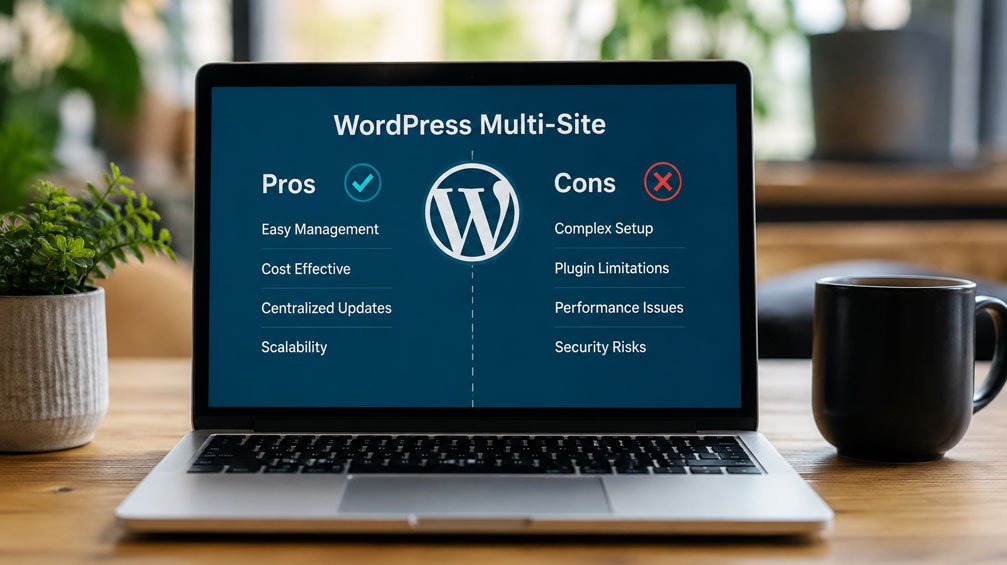
| Security & Operational Vector | Isolated Standalone Installations (Best Practice) | WordPress Multi-Site Network (The Trap) |
| Blast Radius of an Exploit | Contained entirely to that single site and database. | Network-wide. All 30 sites can be exploited simultaneously. |
| Plugin Flexibility | Each brand chooses plugins tailored to their specific market. | Locked down. Forced to use network-approved plugins only. |
| Database Efficiency | Small, clean, fast individual databases. | Massive, shared, highly complex database prone to bloat. |
| IP & Link Profile Footprint | Can be distributed across different servers/CDNs cleanly. | Identical server footprint; high risk of “link neighborhood” issues. |
When is WordPress Multi-Site Actually Appropriate?
WordPress Multi-site is a powerful, brilliant piece of engineering—but it was designed for a very specific use case. It is meant for a single entity that operates multiple sub-divisions under a shared organizational umbrella, where the sites share a common design language, technical staff, and functional requirements.
- Higher Education & Universities: A main university website with hundreds of sub-sites for individual academic departments, student clubs, and research labs (e.g.,
biology.university.edu). - Corporate Intranets or Franchise Models: A national brand with hundreds of local franchise locations that must use the exact same corporate design layout, brand guidelines, and core features, varying only by localized contact info and regional blogging.
- Multilingual or Regional Expansions: A single brand scaling internationally that requires separate regional iterations of the identical site structure (e.g.,
brand.com/uk/,brand.com/fr/) managed by an in-house global team.
Protect Your Clients, Isolate Your Code
Convenience should never override security and technical performance. Building a multi-site network to host 30 independent commercial brands is an architectural shortcut that compromises data integrity, leaves client assets exposed to cross-contamination, and chokes individual SEO potential.
If you are managing client sites, keep them separate. Use a centralized website management dashboard (such as MainWP, ManageWP, or InfiniteWP) to handle your core and plugin updates across separate server instances. This grants you the operational efficiency of a single dashboard without ever exposing your clients to the shared fate of a single point of failure.
Unsure if your website architecture is hurting your SEO or security? Contact us today for a technical audit.