
Blog
SEO in the Age of AI: How Search Is Changing and What Still Matters
For more than two decades, search engine optimization has followed a fairly familiar formula.
Find the keywords people are searching for. Create useful pages around those keywords. Optimize titles, headings, links, images, page speed, and technical structure. Earn authority. Work your way toward the top of Google.
That formula isn’t disappearing.
But it is changing.
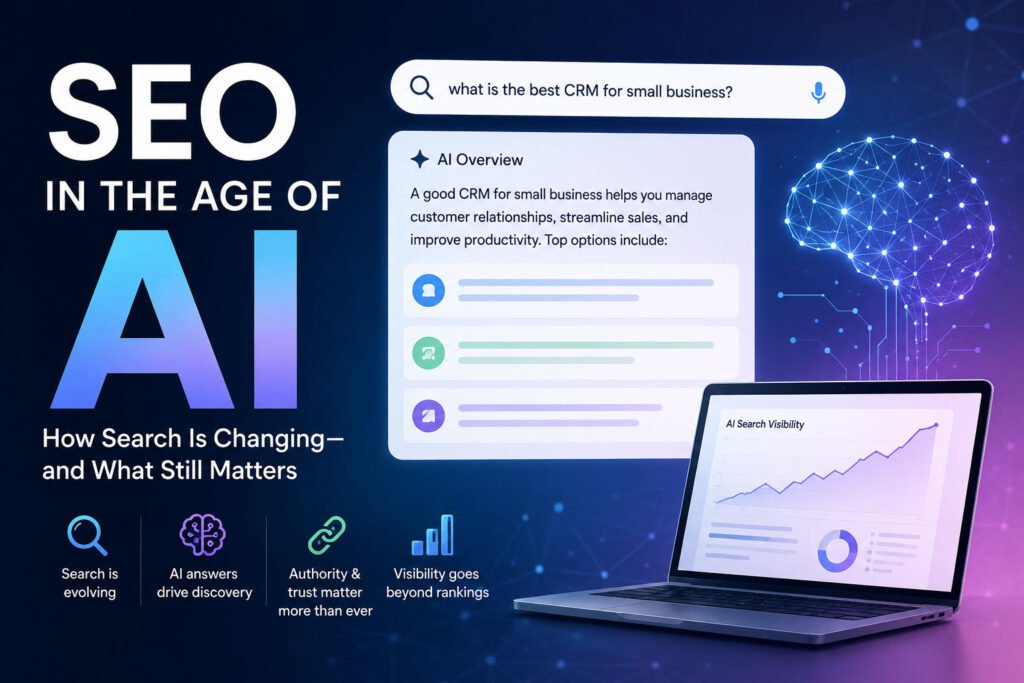
Artificial intelligence is altering not only how search engines display information, but also how people look for it in the first place. Instead of typing a few words into Google and choosing from ten blue links, people can now ask detailed questions and receive synthesized answers from Google AI Overviews, AI Mode, Microsoft Copilot, ChatGPT, and other AI-powered tools.
For businesses, publishers, and SEO professionals, that means the goal is becoming bigger than simply ranking #1.
The new question is:
Will your website become one of the sources AI trusts enough to use when constructing an answer?
Traditional SEO Isn’t Dead
Despite some dramatic predictions, SEO is not becoming obsolete.
In fact, Google explicitly says that its existing SEO best practices remain relevant to AI Overviews and AI Mode. Pages still need to be crawlable and indexable, important content still needs to exist as readable text, internal linking still matters, structured data should accurately reflect page content, and websites still need to provide a good user experience.
In other words, we aren’t throwing away SEO.
We’re building another layer on top of it.
Technical SEO, good website architecture, quality content, backlinks, accessibility, page performance, metadata, and search intent are still important.
But optimizing a page solely around a keyword phrase is becoming less powerful than it once was.
Search Is Becoming a Conversation
Traditional search queries tend to be short:
best accountant tucson
wordpress security plugin
how to fix broken links
AI search encourages something very different.
A user might instead ask:
“I’m a small business owner in Tucson with a WordPress website. I don’t sell products online, but I collect customer information through forms. What security measures should I have in place?”
That’s not really a keyword.
It’s a problem.
And that’s an important distinction.
AI-powered search systems are increasingly designed to understand the meaning, context, relationships, and intent behind a question, rather than simply matching a string of words to another string of words.
Google says people using its AI search experiences are asking longer, more complex, and more conversational questions.
That means successful SEO content will increasingly need to answer real questions instead of merely targeting search phrases.
Keywords Still Matter—But Topics Matter More
Keywords aren’t going anywhere.
They remain valuable clues about what people want.
The difference is that a good SEO strategy should no longer stop at:
“What keyword should we rank for?”
It should continue with:
“What does someone searching for this actually need to know?”
A strong page about WordPress security, for example, might naturally explain:
- WordPress security basics
- Malware protection
- Firewall options
- Login security
- Two-factor authentication
- Plugin vulnerabilities
- Backups
- Spam protection
- Hosting security
- What to do after a site is compromised
That creates a much more complete understanding of the subject than repeating “WordPress security” twelve times throughout the page.
Search engines have been moving in this direction for years. Generative AI accelerates it.
From Ranking to Being Referenced
One of the biggest changes may be how we define “visibility.”
Historically, SEO success was easy to picture:
Position 1. Position 2. Position 3.
AI-generated answers don’t always work that way.
An AI system may gather information from several sources and combine those sources into one response. Your page might contribute to the answer without appearing as the first traditional organic result.
Microsoft has already acknowledged this change directly. In 2026, Bing Webmaster Tools introduced AI Performance reporting that shows website owners when their pages are cited in AI-generated answers across supported Microsoft AI experiences.
Google has also introduced dedicated generative-AI performance reporting in Search Console.
That tells us something important about where search is headed.
We may increasingly measure:
Rankings + Traffic + Mentions + Citations + AI Visibility
rather than rankings alone.
Originality Is Becoming More Valuable
There is another interesting consequence of AI search.
Generic information has become incredibly easy to produce.
Ask an AI tool to write “10 Tips for Better Email Marketing” and it can create a perfectly readable article in seconds.
That means simply publishing information is no longer enough.
The internet doesn’t desperately need its 47,000th generic explanation of why strong passwords are important.
What becomes more valuable is information that adds something new:
- Firsthand experience
- Testing
- Original research
- Case studies
- Expert observations
- Photos
- Examples
- Comparisons
- Data
- Tutorials based on actual experience
- Tools and calculators
- Strong opinions supported by evidence
- Solutions to unusually specific problems
Google’s current guidance for generative AI search specifically emphasizes valuable, unique, non-commodity content rather than content that merely repeats information already available elsewhere.
Ironically, the more AI-generated content floods the internet, the more valuable genuine human experience may become.
AI Can Write Your Content but That Doesn’t Mean It Should Write All of It
There is nothing inherently wrong with using AI to help create website content.
AI is excellent for brainstorming, research assistance, organization, editing, outlines, summarization, and turning expertise into a more readable format.
The danger comes when businesses use AI to manufacture hundreds or thousands of pages that say essentially the same things everyone else is saying.
Google’s guidance makes an important distinction here: using generative AI itself isn’t the problem, but generating large amounts of content without adding value can violate its policies on scaled content abuse.
The better approach is:
Human knowledge + AI assistance.
Give AI your experience, observations, examples, data, screenshots, opinions, discoveries, and expertise.
Let it help you communicate those things more effectively.
That’s very different from asking:
“Write 500 SEO articles.”
Websites Need to Become Easy to Understand
Good technical SEO may actually become more important in an AI-driven search environment.
An AI system cannot confidently retrieve information from a website that search engines have trouble crawling, interpreting, or indexing.
Clear site architecture matters.
Descriptive headings matter.
Internal links matter.
Semantic HTML matters.
Structured data matters when appropriate.
Clear product, service, author, organization, and contact information matters.
So does having important information available directly in HTML rather than hiding everything inside scripts, images, or interfaces that crawlers struggle to interpret.
AI search may feel futuristic, but much of its success still depends on some decidedly traditional web-development fundamentals.
Write Content That Is Easy to Extract and Understand
There is also a practical writing change businesses can make.
Answer questions clearly.
Don’t make visitors read eight paragraphs of introduction before telling them what they came to learn.
A useful page can include:
A direct answer first.
Then explain the details.
Use descriptive headings.
Use lists when lists make sense.
Use comparison tables when comparing things.
Define terminology.
Include FAQs when they genuinely answer additional questions.
Connect related subjects using internal links.
This benefits people, traditional search engines, and AI systems alike.
It isn’t about “writing for robots.”
It’s about communicating information clearly.
Brand Recognition Will Matter More
There is another aspect of AI visibility that businesses shouldn’t ignore: brand authority.
If information about your company exists consistently across your website and reputable third-party sources, search systems have more context for understanding who you are and what you do.
That can include:
- Your website
- Business profiles
- Professional directories
- Industry organizations
- Reviews
- Social profiles
- Interviews
- Press coverage
- Citations
- Other reputable websites mentioning your brand
Traditional link building isn’t necessarily disappearing, but the bigger objective is becoming building a recognizable entity with a trustworthy digital footprint.
The goal isn’t just to make a page look important.
It’s to make the business behind the page demonstrably real, relevant, and knowledgeable.
Zero-Click Searches Will Continue to Change Traffic
There is an uncomfortable part of this transition.
Some searches that once resulted in a website visit can now be answered directly on the search results page or inside an AI response.
A person looking for a simple definition may no longer need to click through to a website at all.
That doesn’t mean websites become irrelevant.
It means we need to give people a reason to visit.
Original tools, detailed tutorials, products, services, communities, downloadable resources, firsthand research, interactive features, expert consultation, videos, calculators, unique images, and deeper information become increasingly valuable.
If everything important about a page can be completely summarized in two sentences, AI probably can summarize it.
Give the visitor something worth clicking for.
SEO Is Becoming Optimization for Discovery
We may eventually decide that “search engine optimization” is too narrow a phrase for what SEO professionals actually do.
Someone may discover a business through:
Google.
An AI Overview.
Google AI Mode.
Bing.
Microsoft Copilot.
ChatGPT.
YouTube.
Reddit.
A social network.
A local search.
An AI assistant we haven’t even heard of yet.
The larger job is becoming digital discoverability.
The principles behind good SEO still sit at the center of that ecosystem, but ranking on a traditional search results page is no longer the only possible destination.
What Should Businesses Do Now?
Fortunately, businesses don’t need to panic and rebuild their websites for some mysterious new algorithm.
Start with what has always worked and improve it.
Create genuinely useful content.
Keep your website technically healthy.
Write for real customer questions instead of stuffing keywords.
Build clusters of expertise around subjects important to your business.
Provide clear answers.
Add firsthand experience whenever possible.
Use descriptive page structure.
Keep important information current.
Develop your brand outside your own website.
And continue paying attention to traditional SEO.
Google itself says there are currently no special AI files, secret schema types, or additional technical requirements needed to appear in its AI search features.
That’s reassuring.
You don’t need to abandon everything you know about SEO.
You simply need to understand that the finish line is moving.
The Future of SEO Is Not Man vs. Machine
AI isn’t necessarily replacing SEO.
It is changing what SEO is optimizing for.
For years, the challenge was getting a search engine to recognize that your page deserved to be included in its list of results.
The emerging challenge is getting machines to understand that your website is a reliable source of information worth referencing when they answer someone’s question.
That rewards many of the same things good SEO has always rewarded:
Expertise.
Clarity.
Accessibility.
Originality.
Authority.
Trust.
And usefulness.
The websites that struggle may not be the ones that “failed to optimize for AI.”
They’ll be the ones that never offered anything an AI couldn’t reproduce without them.
And that may ultimately be one of the healthiest changes search has seen in a very long time.